PROGAT

PROGAT

Aims

The main goal of PROGAT device is to reduce the amount of bruising that beef cattle suffers during transport to the slaughter house. An improvement in this area can rise the amount of beef finally sold and exported, being injuries and lesions one of the main cause of meat loss in abbatoirs (check link).

Blacken meat cannot be sold and therefore, minimizing contusions caused by transport will mean increasing profits for both producers and slaughter houses.


About PROGAT

PROGAT (for its name in spanish, cattle protection during freights) it is build up mainly by two big items: protecting plates made out of a high density elastic polymer and retractible metallic funnels.

Tough materials make the device highly resistant to harsh  weather conditions, dust, road vibrations and even cow droppings. In addition, its simple construction allows to install it in a few hours work, for which the truck has not to be put out of service for a long time.

Imagen Imagen

Protective plates

 These plates are installed next to each other creating a protective band inside the truck, at a height that enables them to cover the most expensive cuts from banging against the surface of the truck.

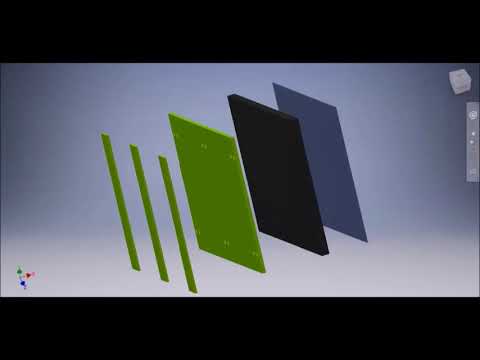
They are built in separate layers, being the first one a solid plate made out from recicled plastic bits (on green in the image). Shredded plastic is heated and pressed to form a solid piece, over which comes the rubber layers (blue and gray). This is a high density polymer vulcanized to the solid part. The final piece is screwed to the lorry by four screws located one in each tip, avoiding the plates to come out or move from their initial position.

The plastic part has, on the side that leans against the truck, three band made out of the same material, which allow a space between the protective plate and the truck. This space contributes to water flowing, not allowing water or any other fluids to rest on top of the plate which would reduce the life span of the materials. This also contributes to cleaning tasks, helping water flow easily, washing away dirt and drying out easily.

With these plates, cattle inside the truck will never lean against a hard surface, and whenever they move to vigorously they will hit themselselves against a cushioned material. This way, contusions can be reduced to a minimum, and serious injuries that might even get to the bone, are completeley eliminated.

In addition, using recicled materials contribute to reduce costs and make the device eco friendly, showing comittment in both animal welfare and  environmental awareness.

Imagen Imagen

Retractible funnels

The funnels are located on each side of the truck's gates, both on the rear and the inner gate that divides the truck's compartments. The funnels are made from galvanized steel, making them highly resistant to corrosion.

These funnels work with compressed air, which comes directly from the truck. Because of the air brakes, every truck has its own air compressor used to supply brakes and other appliances such as driver's seat and cabin. Truck also have an extra gauge whic is left unused, providing the truck driver eventually will connect a neumatic device. This gauge is where PROGAT device connects to get the compressed air for the funnels. 

Once its ready for the load and with the gates up, the driver can activate PROGAT with switches located beneath each gate. The air pumps through pistons wich open the funnels, making it easier for cattle to get in the truck one at a time. The funnels provide a much bigger surface to lean against, instead the edge of the gate. Once the load is ready, the same switch will let the air out of the system, bringing the funnels back to their initial position so the driver can lower the gates.

Making the device work with a separate air distribution line is also a safety measure beacuse a failure in PROGAT would not interfere with any of the other air relying appliances, such as brakes.

Imagen Imagen

PROGAT was tested in fice different abbatoirs in Uruguay. Two truck were used for the experience, in which one had PROGAT installed. Both trucks loaded in the same farm and carried cattle to the same slaughter house, covering distances from 20 up to 300 miles. Once slaughtered, meat was compared and evaluated by veterinarians who work on the animal welfare department of the state university (read article).

The results were consistent with the idea that marked the beggining of the project, showing that PROGAT can reduce lesions and contusions up to a 25% compared to unprotected trucks.

Check out PROGAT at work on the video below.

Imagen
Imagen